Research
My research examines how regulatory systems and institutional design shape incentives, allocate risk, and influence long-term stability across markets and governance systems. I analyze these dynamics across sectors including sports, financial regulation, healthcare policy, and environmental governance.
Comfort and Participation in Political Discussions in Shared Spaces
This research examines how institutional environments and social structures shape participation, expression, and governance legitimacy in shared public spaces. It explores how institutional context influences engagement and decision-making processes.
In recent years, the role of political discourse in shared spaces such as classrooms, lectures, and professional environments has become increasingly complex. While these spaces are often promoted as forums for open dialogue, many individuals report feeling reluctant to engage in political discussions due to various social, ideological, and institutional factors. This study examines the degree to which individuals feel comfortable participating in political conversations in public and professional settings and identifies the key conditions that either enable or inhibit their willingness to speak.
A quantitative survey was administered to a diverse group of respondents, including high school and university students, graduate students, educators, and corporate professionals. A small subset of respondents also identified as “Other,” which may include stay-at-home parents, unemployed individuals, or those outside traditional academic or corporate roles. The survey included 17 questions and incorporated multiple-choice, Likert-scale, and optional short-answer formats. 103 complete responses were collected and analyzed.
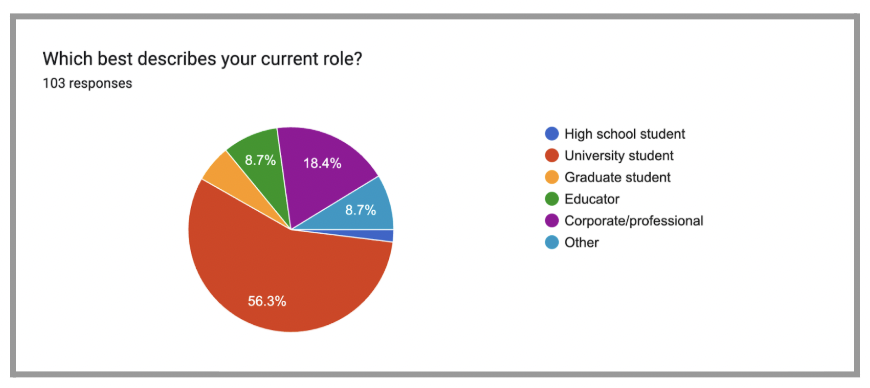
Chart 1
The data reveals a widespread pattern of disengagement from political discussion, with over 85 percent of respondents reporting that they had at some point avoided speaking in a public or professional context due to the political nature of the topic. This avoidance occurred even in contexts where respondents were not asked to share their personal political beliefs directly. The mere presence of political framing, terminology, or ideologically charged material was enough to discourage many from participating. This suggests that the hesitation is not necessarily a response to personal disagreement with content, but to the perceived social dynamics and risks associated with political discourse in general.
The survey results highlight a notable pattern of political disengagement in both public and professional spaces. Specifically, 85.4% of respondents reported having avoided political discussions at some point due to the political nature of the topic, even when personal beliefs were not directly requested. Additionally, while political conversations were reported as occurring frequently or occasionally, the diversity of voices in these discussions was limited. For instance, 72.8% of respondents expressed that political discussions often felt ideologically imbalanced, with a tendency for certain viewpoints to dominate the conversation. When asked about the frequency of political content in their environments, nearly 78% of respondents expressed that they encounter politically charged material at least occasionally. These percentages demonstrate that while political discourse is a regular feature in many spaces, a significant portion of individuals feel hesitant to participate in or challenge these discussions. Chart 2 further illustrates this dynamic, indicating that nearly 90% of respondents encounter politically charged content either frequently or occasionally, underscoring the disconnect between the prevalence of such discourse and the willingness to actively engage in it.
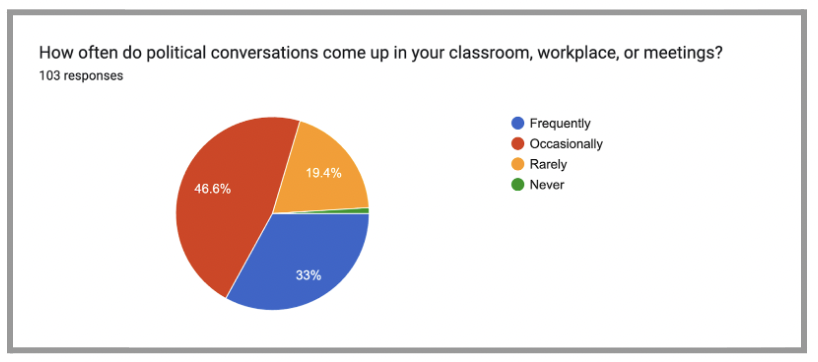
Chart 2
Despite these high rates of disengagement, a majority of respondents also reported that political conversations occur frequently or occasionally in their environments. The data thus indicate that the presence of political discourse does not equate to inclusive participation in that discourse. Many respondents expressed that while such conversations are common, they are often dominated by a narrow range of perspectives. One respondent noted, “When political topics come up, it tends to quiet some voices... only the same few voices who are comfortable talking, likely because they feel the professor shares their views, are the ones being heard.” This dynamic was particularly salient among respondents who identified as centrist or right-leaning, many of whom described academic and professional environments as strongly or slightly left-leaning. These individuals were more likely to report feeling silenced, uncomfortable, or likely to disengage when political topics were raised. However, even respondents who identified as left-leaning acknowledged that dominant ideological tendencies in their institutions often suppress diverse perspectives and discourage dissent.
The perception of ideological imbalance emerged as a central factor influencing participation. Respondents frequently described environments in which political discussions were framed through a specific lens, often aligning with the majority view in that space. As a result, many individuals felt that their contributions, particularly if they represented a minority opinion, would be either dismissed or interpreted as socially or morally problematic. One respondent remarked, “I believe that certain political viewpoints in an academic setting are often seen as more ‘correct’ or ‘moral’ than others, and people are often seen as better or worse people based on how their political views align with the group.” Another added, “Comfort to share my opinion depends greatly on the people I’m with and whether I know they’re willing to hear and accept my viewpoint or try to ruin my life without giving it a second thought.” These reflections underscore how social risk often outweighs personal conviction in determining whether individuals participate.
Behavioral responses to politically charged content varied significantly depending on perceived ideological alignment and contextual support. A minority of respondents reported that they would raise questions or express disagreement when political positions were presented as fact. However, a substantial portion indicated that they would remain silent, feel uncomfortable, or mentally disengage from the conversation. These tendencies were not isolated to any one political orientation but were broadly distributed across ideological lines, reinforcing the conclusion that perceived safety and inclusion are key determinants of participation. Regardless of political identity - left-leaning, right-leaning, or centrist - respondents expressed similar concerns about feeling constrained, judged, or excluded. The results indicate a shared discomfort that transcends political alignment and instead reflects a deeper uncertainty about the safety and balance of the spaces in which these discussions take place.
Another significant theme that emerged in both scaled responses and written comments was discomfort when political material was presented as fact by authority figures such as professors or managers. While the content itself was not always controversial, the way in which it was framed, without space for alternative interpretations or critical engagement, contributed to a sense of ideological rigidity. Respondents described this approach as discouraging, particularly when disagreement was implicitly equated with ignorance or moral failing. One participant noted, “It’s not that I don’t agree with what’s being taught, it’s that there’s no room to ask questions about it. It’s presented as if there’s only one correct perspective.” Another reflected, “When someone in authority shares political content as if it’s settled truth, it makes it almost impossible to speak up without sounding combative or ‘wrong.’” These dynamics suggest that even politically aligned individuals may feel hesitant to engage when the framing of content precludes critical examination. The authority of the speaker amplifies the perceived risk, reinforcing silence and conformity rather than open dialogue. This dynamic is reflected in Chart 3, where over 40% of respondents reported either disengaging or remaining silent when political opinions were presented as fact by an authority figure illustrating how such framing discourages meaningful participation even among those who might otherwise be engaged.
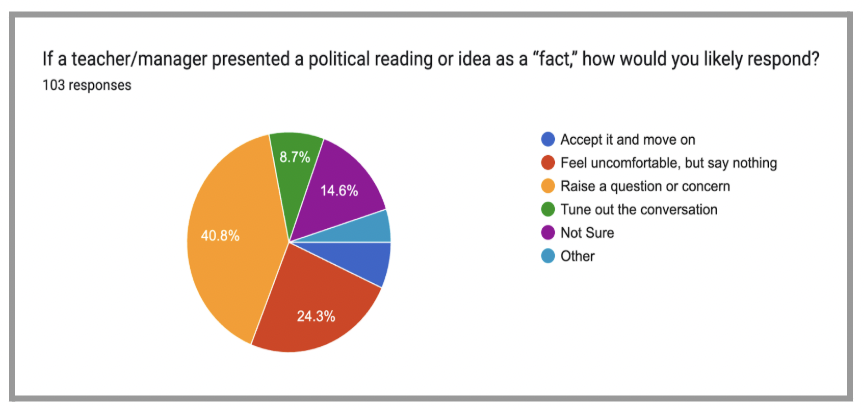
Chart 3
When asked what would make them more likely to engage in political conversations, respondents most frequently selected options such as a more neutral or moderated space, assurance of no judgment, greater ideological balance, and a clearer connection between the political content and the subject matter at hand. These responses indicate that individuals are not inherently opposed to political discussion but are highly sensitive to the context in which it occurs. Open-ended comments further emphasized this point, with many participants underscoring the importance of structured dialogue, respectful disagreement, and the ability to voice minority perspectives without fear of reprisal. One respondent reflected, “I strongly believe there is value in having these conversations, but only if every voice feels comfortable and safe expressing their views, especially if their views are separate from those of their professor and peers.” Chart 4 visually reinforces these findings, showing that respondents were most encouraged to participate when discussions were held in moderated, nonjudgmental, and ideologically balanced spaces, with a clear link between political content and the subject matter at hand.
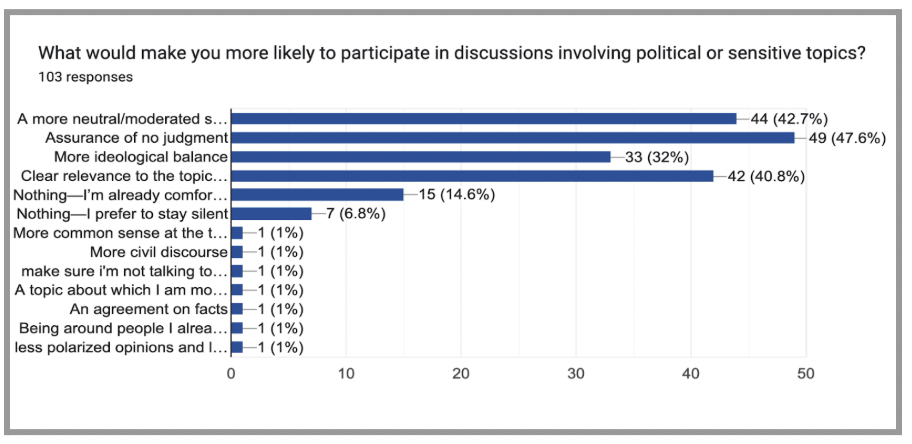
Chart 4
The data also revealed a perception among respondents that political dialogue has become increasingly performative or polarized. Several comments referenced a lack of genuine engagement or nuance, stating that participants often “just recycle talking points” or that “people only speak up when they’re surrounded by like-minded individuals.” This climate discourages exploratory thinking and deep engagement, and instead fosters ideological echo chambers. One respondent noted, “Politics has become too polarized. Everyone has their mind made up one way or the other, and constructive conversation is few and far between.”
These findings carry implications for academic and professional institutions that aim to promote open dialogue. Facilitators, whether professors, managers, or discussion leaders, must be aware of how their framing, tone, and ideological positioning influence who feels safe to speak. Simply encouraging open dialogue is insufficient; institutions must intentionally create conditions where a broad range of perspectives can be expressed without fear of judgment or marginalization. This includes establishing clear expectations for respectful disagreement, ensuring ideological diversity in course content and workplace programming, and adopting discussion formats that support balanced participation.
Still, it is important to consider a potential critique: that calls for neutrality, civility, or moderation in political discourse might reflect a conservative or exclusionary impulse. However, the conclusions drawn here are grounded in consistent patterns across ideological lines. The survey data reveal that respondents identifying as left-leaning, centrist, and right-leaning alike described environments where ideological dominance discouraged dissent and suppressed engagement. The desire for neutral or moderated spaces did not stem from an effort to shield dominant views, but from a broad concern that political discourse in shared settings often feels exclusionary, performative, or morally prescriptive. In fact, several left-leaning respondents reported similar discomfort when prevailing narratives seemed to foreclose critical engagement or stigmatize disagreement. Interpreting these preferences as inherently conservative overlooks the diversity of perspectives reflected in the data. Rather than reinforcing existing power structures, the call for more inclusive and balanced environments reflects a fundamentally democratic concern: ensuring that all individuals feel safe and respected in contributing to complex political conversations. It is this commitment to openness, not ideological alignment, that underpins the conclusions of this study.
Several limitations must be acknowledged. The survey sample was not random and included a disproportionate number of university-affiliated respondents, which may have influenced the ideological distribution and generalizability of the findings. Additionally, the data relies on self-reporting, which may be subject to social desirability bias or selective memory. A few respondents identified as “Other,” suggesting the inclusion of perspectives from individuals who may be unemployed, retired, or working outside traditional institutions - groups that warrant further attention in future research. Future studies could also explore these dynamics using larger and more representative samples, and could benefit from qualitative interviews or controlled experiments that examine how specific interventions affect engagement with political content.
In conclusion, the data reveals that political discussions in shared spaces are marked by a tension between visibility and silence. While such conversations occur with some frequency, meaningful engagement is often hindered by perceived ideological dominance and fear of social consequence. Over 100 participants across the political spectrum indicated a desire for more neutral, moderated, and inclusive environments that allow for thoughtful expression without personal risk. If institutions aim to cultivate genuinely open dialogue, they must move beyond rhetorical commitments to openness and begin implementing structures that make such dialogue possible.
*Originally Published April 21, 2025. Updated January 25, 2026.
Rethinking Recycling: Climate Consequences and the Case for Ecobricks in the United States
This research examines how regulatory frameworks and institutional incentives shape environmental outcomes. It analyzes how policy design influences behavioral participation and institutional effectiveness in addressing environmental challenges.
Climate change remains a pressing global issue, largely driven by unsustainable production, consumption, and waste management practices. In the United States, the public perception of recycling as a solution to environmental degradation is deeply embedded in civic behavior and national policy. However, this perception often conceals the harsh reality that much of what Americans place into recycling bins never reaches a second life. Despite decades of campaigns promoting recycling, the United States recycles only about five to six percent of its plastic waste, with the remainder either landfilled or incinerated (Greenpeace USA, 2022). The gap between intention and outcome not only undermines public trust in sustainability efforts but also exacerbates the climate crisis by continuing the cycle of fossil fuel extraction for new plastic production.
This systemic failure in the United States' recycling infrastructure necessitates a critical examination of alternative strategies for managing plastic waste. One such alternative, the ecobrick, presents a grassroots solution that encapsulates both physical and educational benefits. Ecobricks are densely packed plastic bottles filled with non-recyclable soft plastics, used to create modular building materials. They serve a dual purpose: removing plastic from ecosystems and acting as tools for environmental awareness and behavioral change. While not a panacea, ecobricks offer an opportunity to redirect consumer responsibility into more meaningful climate action. This paper argues that the failure of conventional recycling systems in the United States not only hinders progress on climate change but also necessitates the exploration of community-driven innovations like ecobricks, which offer both environmental and structural benefits in the context of carbon reduction.
One critical, often overlooked dimension of the recycling crisis is the role of corporate lobbying and the petrochemical industry in shaping public policy. Major fossil fuel companies have historically supported campaigns promoting recycling as a solution to plastic pollution, despite being aware of its technical and economic limitations. By promoting consumer-focused solutions like recycling, these companies deflect attention from upstream accountability and maintain demand for virgin plastic, which is a lucrative byproduct of oil and gas refining. As a result, policies that could limit single-use plastics or introduce producer responsibility measures face strong resistance. This political inertia reinforces the status quo and restricts innovation in both policy and infrastructure, allowing plastic production to continue nearly unchecked (Greenpeace USA, 2022).
The decline in effective recycling in the United States can be attributed to multiple systemic flaws, including economic disincentives, lack of infrastructure, and poor public education on material sorting. After China's 2018 ban on importing foreign plastic waste, the United States faced a sharp reduction in markets for its recyclables, revealing a heavy dependence on overseas processing (EPA, 2020). Prior to this, the country exported a significant portion of its plastic waste, often without transparency regarding its final destination. Following the ban, domestic processing systems struggled to adapt, and many materials that had previously been collected for recycling were rerouted to landfills or incinerators. According to the Environmental Protection Agency (2020), only 8.7 percent of plastics were recycled in 2018, while over 75 percent ended up in landfills and nearly 16 percent were combusted for energy recovery. This shift not only wastes materials but significantly contributes to greenhouse gas emissions, especially when incineration is used as a fallback method.
The consequences of this inefficiency are environmental as well as psychological. When citizens believe they are contributing to sustainability by recycling, only to learn that their efforts are ineffective, disillusionment and apathy may result. Furthermore, continued reliance on ineffective systems delays more impactful policy shifts, such as mandatory producer responsibility or bans on single-use plastics. It also allows for the continued growth of virgin plastic production, which is projected to rise even as global climate goals demand steep emissions reductions. This dissonance between belief and impact highlights the urgent need for alternative strategies that can reduce waste, contain non-biodegradable materials, and empower individuals to participate in real climate solutions.
Another important consideration is the intersection of environmental justice and waste management. Landfills and incinerators are disproportionately located in low-income communities and communities of color, which means that the environmental and health consequences of inadequate recycling systems are not distributed equally. These communities are more likely to experience air pollution, water contamination, and other hazards associated with waste processing. In this context, ecobricks offer not only an environmental benefit but also a justice-oriented one. By reducing the volume of waste sent to polluting facilities, they can alleviate some of the burden borne by marginalized populations. When implemented with community input and equitable resource distribution, ecobrick projects can foster environmental empowerment and resilience in under-resourced areas (MIT, 2023).
Ecobricks are hand-crafted modular units created by compressing clean and dry, non-recyclable plastic waste into plastic bottles. This method represents a decentralized, low-cost approach to mitigating the environmental impact of synthetic waste, particularly in areas where formal recycling systems are ineffective or absent. The process involves collecting soft plastics such as food wrappers, chip bags, and multilayered films, which are commonly excluded from municipal recycling programs due to contamination or their complex composition. After cleaning and drying the materials, individuals use simple tools to compact them into polyethylene terephthalate bottles until the container becomes firm and structurally stable. According to Akinrata et al. (2021), the resulting bricks are strong enough for use in small-scale construction, including benches, walls, and modular furniture. This hands-on approach contrasts with industrial recycling systems, which consume substantial energy and often contribute to greenhouse gas emissions. Ecobricks, by comparison, immobilize plastic waste without additional processing. From a systems-thinking perspective, the practice aligns with sustainability education principles by integrating ecological awareness with participatory learning and tangible outcomes.
The functional value of ecobricks extends beyond their utility as construction materials. As a form of plastic sequestration, they contain and stabilize materials that would otherwise contribute to environmental degradation through incineration, landfill accumulation, or leakage into marine systems. This containment transforms waste into a usable resource, which is consistent with principles from circular economy frameworks that emphasize reuse and redesign rather than disposal. Additionally, the manual labor required in creating ecobricks invites participants to engage in reflective environmental behavior. Handling personal waste in a sustained, physical manner fosters a deeper understanding of material lifecycles and often leads to reductions in overall consumption. Akinrata et al. (2021) suggest that the educational applications of ecobricking promote long-term behavioral change, particularly when integrated into community-based sustainability programs. Rather than depending solely on top-down solutions, ecobricks exemplify a model in which local knowledge, individual agency, and environmental literacy intersect to create meaningful climate action at the grassroots level.
From an engineering perspective, ecobricks have shown promising mechanical properties. A comparative study by Nguyen and Le (2022) found that PET bottle bricks, when used properly, can rival the strength of some conventional masonry units. While not suitable for high-rise construction, they offer viable options for low-cost housing, temporary shelters, and community structures, especially in disaster-prone or resource-scarce regions. Their use in humanitarian architecture demonstrates both feasibility and climate alignment, especially when considering the embodied carbon of traditional bricks and concrete. The production of one ton of concrete releases over 900 kilograms of carbon dioxide, whereas ecobricks contribute almost none, since the plastic has already been manufactured and is simply being repurposed (Singh et al., 2020).
Ecobricks also represent a shift in how society conceptualizes responsibility for waste. Rather than relying on municipal systems or foreign nations to process materials, ecobricking places the burden, and the opportunity, into the hands of individuals and local groups. This fosters a sense of agency and can contribute to broader behavioral change, including reductions in plastic use and increased environmental literacy. In regions where recycling infrastructure is lacking or broken, ecobricks can act as both an interim waste solution and a catalyst for community dialogue on sustainability. According to MIT (2023), one of the core challenges facing the U.S. recycling model is the disconnection between production and accountability. Ecobricks provide a means of reconnecting the public with the consequences of consumption, one bottle at a time.
The educational potential of ecobricks is another valuable aspect of their implementation. In schools, environmental workshops, and youth centers, the process of creating ecobricks introduces participants to concepts of material lifecycle, carbon footprint, and civic responsibility. Unlike abstract discussions about climate change, ecobricking is tangible and visual. It reveals just how much plastic one person can generate in a short time. This visibility can catalyze deeper engagement with sustainability efforts, especially among young people. The act of ecobricking can also be incorporated into broader environmental curricula, connecting local action with global challenges. Educators have found that students who participate in ecobrick making often begin reducing their plastic use and engaging family members in waste audits and reuse practices (Akinrata et al., 2021).
In addition to educational benefits, ecobricks reflect a practical application of environmental behavior change theory. This theory suggests that direct engagement with environmental problems, especially through experiential learning, leads to increased motivation and long-term adoption of sustainable practices. When individuals physically interact with their own waste through ecobrick production, they not only contribute to the reduction of plastic pollution but also undergo a cognitive shift in how they perceive consumption. This behavioral transformation is supported by academic frameworks such as the Theory of Planned Behavior, which highlights the role of perceived behavioral control in shaping intentions. The simple act of making an ecobrick fosters a sense of agency and efficacy, reinforcing environmentally conscious decision-making. Moreover, when applied within collective settings, such as classrooms or community groups, ecobricking can strengthen social norms around sustainability and create lasting cultural shifts toward environmental responsibility.
From a global perspective, ecobricks are part of a larger movement to decentralize waste management and empower local solutions. In countries such as the Philippines, South Africa, and Guatemala, ecobricks have been widely adopted as part of community resilience strategies. These regions often lack the infrastructure for conventional recycling and instead rely on manual, low technology methods that are adaptive to local conditions. The success of these programs illustrates the potential scalability of ecobricks, especially in areas where centralized policy interventions are slow to materialize. Grassroots ecobrick networks have produced comprehensive guides, quality control standards, and tracking systems, helping to professionalize what began as a volunteer movement. In doing so, they demonstrate that effective environmental practices need not wait for government action but can emerge organically through collective effort (Nguyen & Le, 2022).
Solving the climate crisis requires a multi-pronged strategy that includes structural reform, technological innovation, and behavioral change. While ecobricks alone will not reverse the damage caused by plastic overproduction and ineffective recycling, they exemplify the type of holistic thinking necessary to build a sustainable future. Their value lies not only in the plastic they contain but in the conversations and collaborations they inspire. As part of a broader suite of interventions, including bans on non-recyclable packaging, investment in closed loop recycling systems, and education reform, ecobricks offer an immediate, accessible, and educational tool for addressing both waste and climate concerns. A reimagined recycling paradigm must move beyond the illusion of circularity and embrace strategies that are grounded in both environmental science and social equity (Singh et al., 2020).
Works Cited
Akinrata, S. A., Aramide, F. O., Adekunle, O. J., & Nwobodo, S. A. (2021). Assessment of plastic bottle bricks for sustainable shelter construction. Journal of Building Engineering, 43, 102568.
Environmental Protection Agency. (2020). Advancing sustainable materials management: 2018 fact sheet.
Greenpeace USA. (2022). Circular claims fall flat again: U.S. plastic recycling rate declines to about 5%.
Massachusetts Institute of Technology. (2023). Why plastic recycling doesn’t work in the U.S. MIT Environmental Solutions Initiative.
Nguyen, T. H., & Le, D. H. (2022). Comparative study of mechanical properties of plastic waste bricks and conventional concrete bricks. Construction and Building Materials, 314, 125585.
Singh, R., Sharma, A., & Kumar, M. (2020). Life cycle assessment of plastic bricks made from post-consumer plastic waste. Resources, Conservation & Recycling, 161, 104925.